
Project Summary
In 1946 Walter Baker, a prospector, discovered boulders containing gold, silver and the sulphides sphalerite, galena, arsenopyrite and pyrite. This property was explored by Imperial & Esso Minerals in the mid 1970's who identified resources of 40,000 tonnes at 15.43 g/t Au, 197.00 g/t Ag, 6.6% Pb and 3.5% Zn in three veins exposed at surface. This was reevaluated in a 1996 report to 199,580 tonnes at 9.59 g/t Au or approximately 61,536 ounces of gold. (Historical estimates not yet verified under NI 43-101 standards – further work is underway to validate and confirm this estimate.) Historic assays of up to 1.4 oz Au/ton and 25 oz Ag/ton have been recorded. Base metal ranges from traces up to 15 percent combined Pb-Zn. Best results include 32.83 g/t Au over 0.27 m at the Baker vein. Best results from the southern part of the L4W vein include 13.5 g/t Au over 0.75m. Best results at the Mersereau vein include 39.7 g/t Au on surface. In 1986 an exploration program discovered a new Au bearing zone, Marleau vein, with an assay of 0.36 oz Au/t over 5.2 feet. The Lac Arsenault property has 93 historic drill holes totaling 7,269.41m.
Potential Bulk Sample in 2026
7,780 Hectares
100% Owned
93 Historic Drill Holes
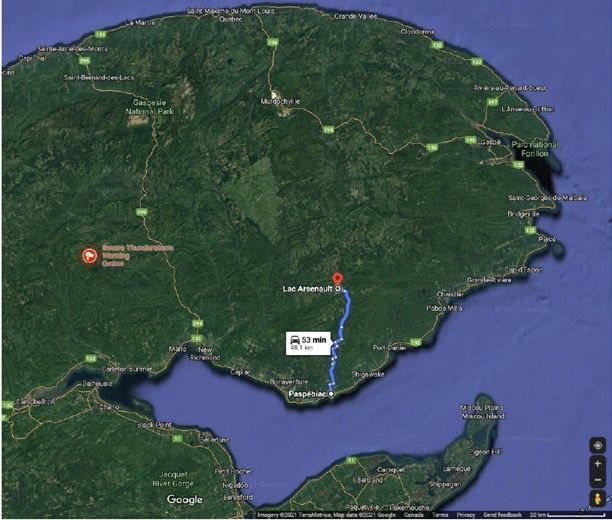
The Lac Arsenault project is located in the Gaspé Peninsula of Quebec, approximately 25 kilometers north of Paspebiac and 58 kilometers from Bonaventure, covering a total of 7,780.6 hectares. The property benefits from convenient access via well-maintained gravel roads, ensuring year-round availability for exploration activities. The region’s temperate climate extends the exploration season, allowing for efficient operations across most of the year.
Bonaventure, located 58 kilometers south, serves as a regional transportation hub with an airport offering regular flights to and from Montreal, as well as connections throughout the Gaspé Peninsula. This proximity facilitates the movement of personnel and smaller equipment, while Bonaventure also provides essential services, accommodations, and supplies, making it well-suited for supporting extended exploration efforts. Additionally, Bonaventure hosts a range of tourist camps that cater primarily to hunters and fishermen, providing lodging options for seasonal workers and field staff.
For larger logistical needs, Port-Daniel—a deep-water sea port on the Bay of Chaleur—is situated about 73 kilometers south of the property, offering support for the shipping of bulk samples and materials. Furthermore, the Canadian National (CN) railway line runs through the Gaspé Peninsula, linking Lac Arsenault to broader shipping routes and reducing transportation costs for future mining operations.
Nearby towns such as Paspebiac and Bonaventure provide access to a skilled labor force familiar with mining operations, and offer essential infrastructure including food, fuel, and specialized equipment suppliers. Additionally, local water resources are available on the property, sufficient to sustain both exploration and potential future mining activities. Together, these advantages make Lac Arsenault’s location ideal for exploration and eventual project development, with efficient access to the essential infrastructure and services required for sustained operations.
Location & Infrastrucuture
The Lac Arsenault property boasts a robust exploration history since its discovery by prospector Walter Baker in 1946. Early work by Imperial & Esso Minerals in the 1970s identified high-grade material across three primary veins (Baker, Mersereau, and L4W), with historical estimates indicating 40,000 tonnes grading 15.43 g/t Au, 197 g/t Ag, 6.6% Pb, and 3.5% Zn. In the 1990s, further calculations by geologists Peter Smith and Peter Hawley estimated a historical resource totaling up to 220,042 short tons at 0.307 oz/ton Au, although these figures are non-compliant with current NI 43-101 standards.
Recent exploration by Ressources Appalaches, 1844 Resources Inc., and others has focused on defining high-grade zones through drilling, channel, and grab sampling. Highlights include drilling intercepts of 7.2 g/t Au over 3m from the Baker vein and 17.9 g/t Au with 201 g/t Ag over 0.3m from the Mersereau vein. Surface sampling has confirmed bonanza-grade zones, such as 32.83 g/t Au over 0.27m in the Baker zone and 39.7 g/t Au in the southern Mersereau zone, underscoring the property’s potential for substantial gold mineralization.
Key Historical Results:
- Baker Vein: Assays of up to 32.83 g/t Au over 0.27m.
- Mersereau Vein: Surface samples with up to 39.7 g/t Au.
- L4W Vein: 13.5 g/t Au over 0.75m.
- Marleau Vein: Discovered in 1986, with assays of 0.36 oz/t Au (12.34 g/t Au) over 5.2 feet (1.58m).
Historical exploration includes trenching, soil sampling, and 93 drill holes totaling 7,269m. These exploration efforts have shown consistent high-grade gold and base metal mineralization, highlighting the project’s significant potential for development.
Historic Exploration
- Ongoing maiden diamond-drilling program
The Company has initiated its maiden diamond-drill campaign at Lac Arsenault, commencing in November 2025, with a minimum of 36 holes totalling approximately 3,000 metres. Following the results of a tightly-spaced induced-polarization (IP) survey across the Baker–Mersereau structural corridor — which identified multiple high-priority vein and stockwork targets in a near-surface (0–30 m) zone — the Company has submitted amended permits to expand the drill programme to roughly twice the originally planned size. The objectives of the drilling include: modernising and validating the historical database; twinning selected historic holes on the Baker and Mersereau veins; step-out drilling to test strike and depth extensions; and ultimately supporting the advancement of an NI 43-101-compliant mineral-resource estimate.
- Bulk-sample programme
The Company plans to execute a 5,000 tonne bulk-sample extraction from Lac Arsenault designed to test near-surface mineralisation and validate metallurgical recoveries ahead of full-scale development. Permits including the Autorisation pour travaux à impacts (ATI) and First Nations approvals have now been received. Originally scheduled for autumn 2025, operational timing has been adjusted — extraction is now targeted for spring 2026, with results and related cash-flow expected in Q3 2026. The bulk sample is expected to provide meaningful technical, geological and recovery-data to de-risk the project and advance future scale-up decisions.
Upcoming Exploration
Gallery
Stay Updated With Canadian Gold
Sign up for our newsletter to receive news releases and exclusive company updates.
Thank you for subscribing to Canadian Gold Resources Mailing List.
Oops, there was an error sending your message.
Please try again.